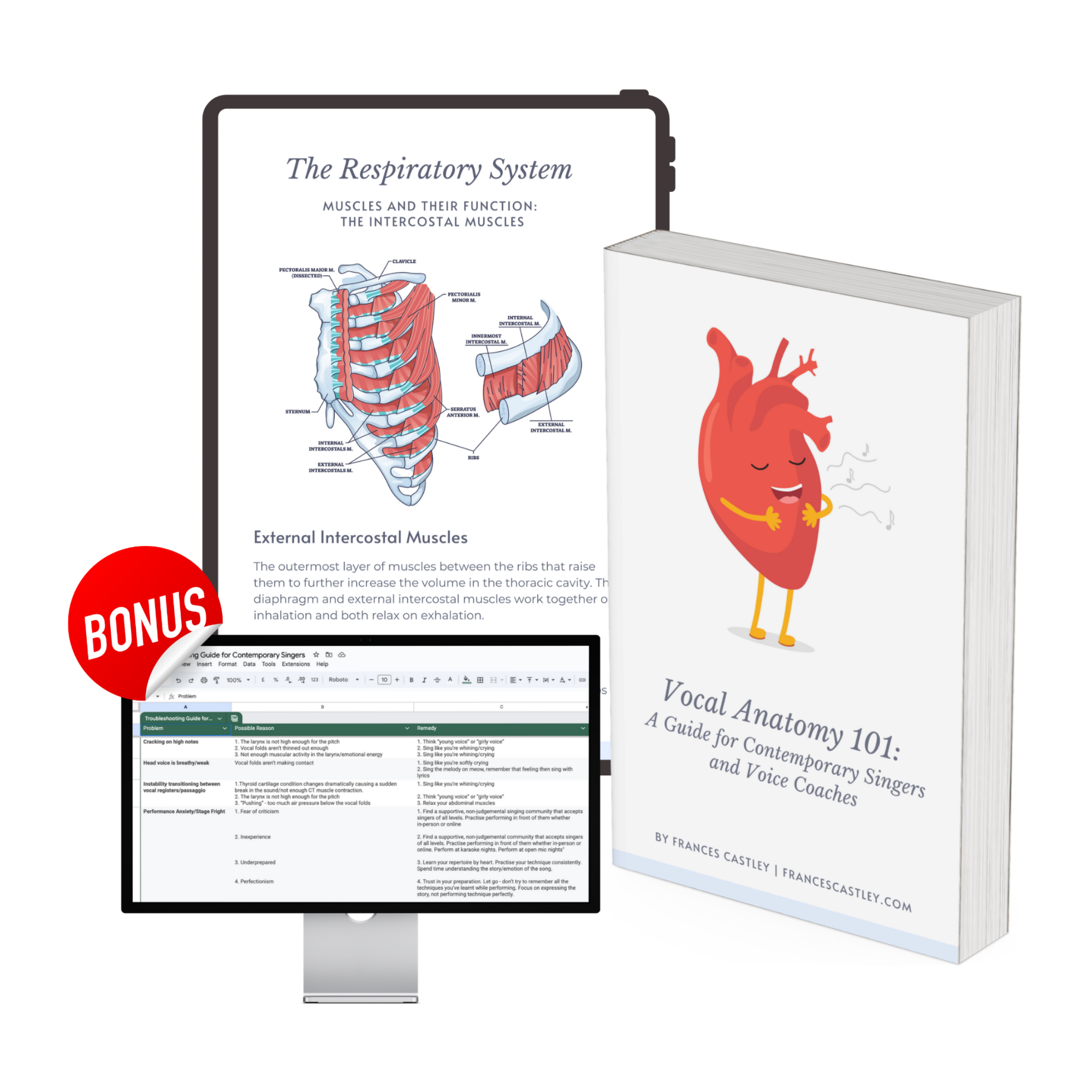
Stop guessing what your voice is doing. Start understanding it.
Vocal Anatomy 101 E-Book: A Guide for Contemporary Singers and Voice Coaches is a 78-page illustrated guide to the respiratory, phonatory and resonance systems — designed to help you understand how the voice actually works and apply that knowledge to singing.
You’ve probably heard advice like “sing from your diaphragm,” “engage your core,” “lift your soft palate,” or “place the sound forward.”
But if you don’t understand what those instructions are actually asking your body to do, singing can become a frustrating game of trial and error.
That was my experience too. I’d completed singing programs and worked with different approaches, but I still felt like I was missing a piece of the puzzle. Once I began approaching the voice through anatomy and voice science, things finally started to make more sense.
Understanding your voice changes the way you use it.
“I came to the lessons very self conscious about my singing ability but keen to develop some skills. I developed an understanding of how my voice works… I went from being frustrated with my voice to being able to enjoy singing with friends at Karaoke”
— Helen, 1:1 studentWhat singers say learning with Frances
What You’ll Learn

Where the energy comes from
Explore how the diaphragm, ribs, abdominal muscles and respiratory system work together when you sing.
01 The Respiratory System
Where sound begins
Discover how the vocal folds create sound and how the muscles of the larynx influence pitch, vocal fold closure, and vocal function.
02 The Phonatory System

Where sound takes shape
See how the tongue, jaw, lips, velum and other structures shape resonance, vowels and tone.
03 The Resonance System
04 Voice Qualities
Go beyond learning what the structures are and discover how they contribute to the sounds you hear in contemporary singing. Explore chest/mixed voice, mix belt, head voice, breathy head voice, falsetto, twang and belt — and start connecting what’s happening physically with what you can actually hear and feel in your own voice.



Who it’s for
This guide is for you if...

You’re a curious singer who wants understand why your voice behaves the way it does, rather than relying on vague instructions, guesswork or trial and error.
You’re a developing singer who wants understand the mechanics behind things like breath, pitch, resonance, registers and different voice qualities — and apply that knowledge to your own singing.
You’re a vocal coach who wants a clear, visual resource to deepen your understanding of vocal anatomy and help explain how the voice works to your students.
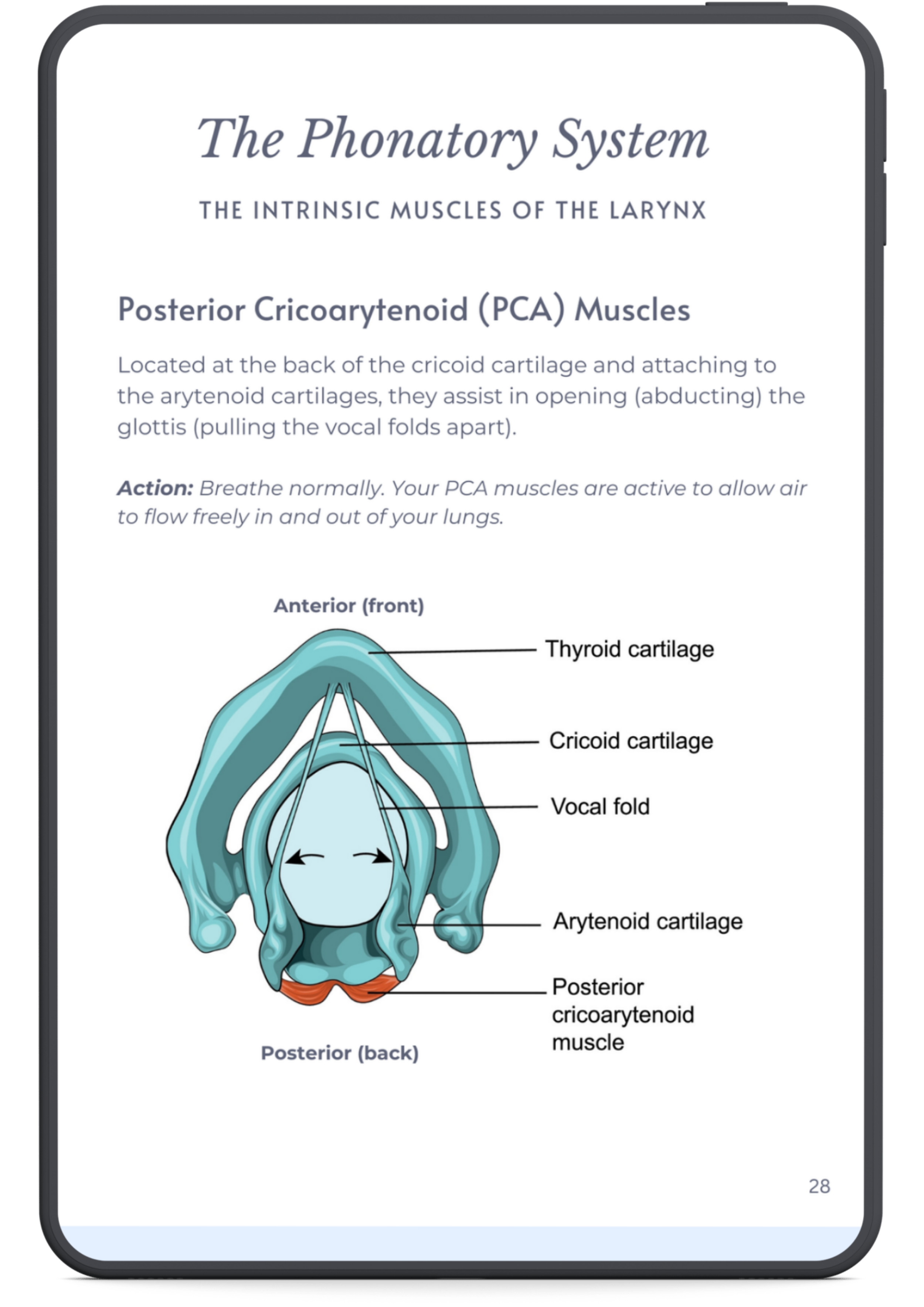
Not just diagrams. Not just theory.
Throughout the guide, anatomy is paired with practical Action exercises — helping you explore what you're learning in your own voice and body.
Experiment with your breathing, vocal qualities, effort, tongue and jaw position, and begin connecting what you feel with what you hear.

Instant Digital Access
$17 AUD
Vocal Anatomy 101
A GUIDE FOR CONTEMPORARY SINGERS AND VOCAL COACHES
78 pages of practical voice science — breaking down complex vocal anatomy into clear, singer-friendly explanations.
Detailed illustrated anatomy diagrams — see the structures involved in singing instead of trying to imagine what’s happening inside your body.
Understand the three systems behind your voice — explore the respiratory, phonatory and resonance systems and how they work together to create sound.
Explore contemporary voice qualities — including chest/mixed voice, mix belt, head voice, breathy head voice, falsetto, twang and belt.
Put the theory into practice — Action exercises throughout the guide help you explore what you’re learning through your own voice and body.
The Voice Break and How to Fix It — understand what’s happening around the break and explore strategies for developing a more coordinated mixed voice.
BONUS: Troubleshooting guide — practical guidance to help you identify what may be getting in the way when something doesn't feel or sound quite right.
Why learn from me?
I’m Frances Castley, a vocal coach with a Bachelor of Music in Contemporary Performance and Estill Figure Proficiency certification.
But my interest in vocal anatomy didn’t come from wanting to memorise a bunch of technical terms. It came from my own frustration as a singer. Even after years of training and performing professionally, there were still things I could do with my voice without really understanding how I was doing them — or why they sometimes worked and sometimes didn’t.
Learning more about vocal anatomy and voice science changed the way I understood singing. It gave me a framework for making sense of what I was hearing and feeling — and it now plays a big part in how I teach my own students.
Vocal Anatomy 101 is the guide I wish I’d had when I was trying to make sense of my own voice.

I like that her lessons are not airy fairy and that her approach is backed by a clear understanding of how the voice works.
— Tony, 1:1 studentWhat singers say learning with Frances
Ready to really understand your voice?
Stop relying on guesswork and start building a clearer understanding of what’s actually happening when you sing.
Vocal Anatomy 101 gives you 78 pages of illustrated vocal anatomy, practical exercises, contemporary voice qualities, troubleshooting guidance and more — all designed to help make your voice a little less mysterious.